Showing posts with label Miana Kan Tue?. Show all posts

2023/08/22

Unleashing Cybersecurity Skills: The World of Capture The Flag (CTF)

In the realm of cybersecurity, there's a game that isn't just about fun, but also about learning, challenges, and honing your hacking skills. It's called Capture The Flag (CTF). 

In this article, we'll delve into what CTF is, how it works, and why it's a crucial training ground for aspiring cybersecurity professionals.

1. Understanding Capture The Flag (CTF)

Capture The Flag (CTF) is a cybersecurity competition that simulates real-world hacking scenarios. Participants solve puzzles, decode messages, exploit vulnerabilities, and ultimately retrieve hidden "flags" to earn points. Flags are unique strings that prove a challenge's completion.

Image: A visual representation of a CTF flag being captured

2. Categories of CTF Challenges

CTF challenges are divided into distinct categories, mirroring the diverse aspects of cybersecurity:

Image: 6 common categories of Cyber Battle: Capture The Flag

2.1 Cryptography:

Cryptography challenges involve deciphering encoded messages, cracking codes, and understanding encryption techniques. You'll encounter various types of cyphers, substitution methods, and algorithms. Participants often need to apply analytical and mathematical thinking to break the encryption.

2.2 Web Security:

Web security challenges are focused on identifying and exploiting vulnerabilities present in web applications. These challenges mimic real-world scenarios where hackers attempt to bypass security mechanisms, execute code injection, or manipulate URLs to gain unauthorized access. 

2.3 Forensics:

Forensics challenges involve analyzing digital artefacts, logs, and files to extract hidden information. Participants may recover deleted files, decipher hidden messages in images, or reverse-engineer malware to understand its behaviour. These challenges test your attention to detail and analytical skills.

2.4 Reverse Engineering:

Reverse engineering challenges require participants to dissect compiled programs or binaries to understand their functionality. You'll explore executable files, disassemble code, and identify vulnerabilities. This category is particularly useful for understanding how malware operates.

2.5 Binary Exploitation:

Binary exploitation challenges involve exploiting vulnerabilities in compiled programs. Participants find ways to manipulate input data to trigger buffer overflows, code execution, or privilege escalation. This category focuses on understanding software vulnerabilities and crafting exploits.

2.6 Network Analysis:

Network analysis challenges focus on analyzing network traffic to uncover vulnerabilities or hidden information. You might examine packet captures, identify potential security flaws, and reconstruct network activities to understand their implications.

3. How Does CTF Work?

CTF participants engage in a variety of challenges:

3.1 Challenge Discovery

Participants select and tackle challenges based on their expertise. (You can refer to heading 2 "Categories of CTF Challenges").

3.2 Problem-Solving 

Image: Cyber Battle participants Source: itpss.com

Once participants choose a challenge category, they dive into solving challenges within that domain.

These challenges simulate real-world scenarios and require participants to:
  • Analyze Code: Examine source code, binaries, or other files for vulnerabilities and hidden information.
  • Reverse Engineer: Disassemble and understand the inner workings of compiled programs.
  • Decipher: Decode encrypted messages, cyphers, and codes using cryptography principles.
  • Examine Artifacts: Analyze digital artefacts like images, logs, or packet captures to extract relevant information.
Challenges require diverse skills, from coding to cryptography.

3.3 Flag Retrieval 

Solving a challenge leads to the discovery of a "flag," a unique piece of text that confirms successful completion. 

Flags are often in the format of alphanumeric strings. They're usually embedded within challenge files, hidden in code, or even transmitted within network packets.

3.4 Scoring

Image: Scoreboard sample of Cyber Battle: Capture The Flag, Source: haxf4rall.com 


For every successfully retrieved flag, participants earn points. The difficulty of the challenge determines the number of points awarded. 

Complex challenges with intricate solutions yield higher points. The participant or team with the most points wins the competition.

4. Importance of CTF Competitions

Capture The Flag (CTF) competitions are more than just challenges; they provide a rich learning experience and numerous benefits that contribute to personal and professional growth. 

Here's an in-depth exploration of the importance of CTF competitions:

4.1 Skill Enhancement and Practical Application:
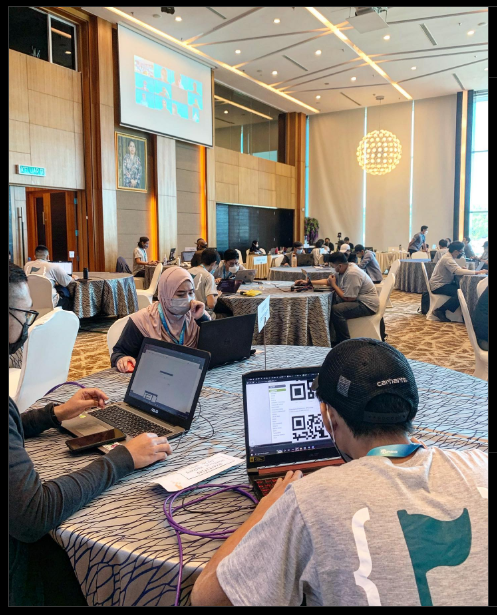
Image: Participants of the Cyber Battle: Capture The Flag. Source: BruCert instagram

CTF challenges mirror real-world cybersecurity scenarios. By actively participating in challenges across various domains, participants enhance their technical skills and apply theoretical knowledge to practical situations. These experiences equip individuals with the ability to identify vulnerabilities, develop exploits, and defend against attacks.

4.2 Problem-Solving and Critical Thinking:


Image: Brainstorming session. Source: wework.com

Each CTF challenge presents a unique puzzle that requires analytical thinking, creativity, and problem-solving skills. Participants learn to dissect complex problems, break them down into manageable components, and develop systematic approaches to find solutions. This cultivates a mindset that's essential for tackling intricate cybersecurity challenges.

4.3 Exposure to Diverse Domains:

Image: Representation of diverse into cybersecurity domains. Source: evelynlim.com

CTF competitions cover a broad spectrum of cybersecurity domains, including cryptography, web security, forensics, and more. This exposure allows participants to explore different areas of interest and expertise. It encourages them to become well-rounded cybersecurity professionals with versatile skill sets.

4.4 Hands-On Learning and Active Participation:

Image: photo of 2016’s Cyber Battle: Capture The Flag competition, Source: itpss.com

Traditional learning methods are valuable, but CTF competitions offer a hands-on and immersive learning experience. Participants actively engage with challenges, experiment with tools, and observe immediate outcomes. This hands-on learning approach accelerates skill development and knowledge retention.

4.5 Teamwork and Collaboration:

Image: representing teamwork and collaboration. Source: quietrev.com

Many CTF competitions emphasize teamwork, fostering collaboration and communication among participants. Joining or forming teams allows individuals to share insights, strategies, and solutions. Collaborative efforts mirror real-world cybersecurity operations, where a diverse skill set is essential for success.

4.6 Competitive Spirit and Motivation:

CTF competitions add an element of competition that fuels motivation. Participants strive to earn points, solve challenges, and achieve a high rank on leaderboards. This competitive spirit drives individuals to continuously improve their skills, explore new techniques, and push their boundaries.

5. Preparing for CTF Success

Successfully participating in CTF competitions requires a combination of knowledge, skills, and strategies. Here's a detailed breakdown of how to prepare effectively:

5.1 Learn Key Concepts

  1. Cryptography: Familiarize yourself with encryption algorithms, decryption methods, and common cryptographic attacks.
  2. Web Security: Understand web vulnerabilities like SQL injection, cross-site scripting (XSS), and request forgery.
  3. Forensics: Learn techniques to analyze digital artefacts, recover deleted data, and reconstruct events.
  4. Reverse Engineering: Study assembly language and understand how to reverse-engineer compiled programs.
  5. Binary Exploitation: Learn about buffer overflows, format string vulnerabilities, and binary analysis.
  6. Network Analysis: Gain insights into network protocols, packet capture analysis, and network attacks.

5.2 Practice Regularly

  1. CTF Platforms: Explore CTF platforms like PicoCTF, Hack The BoxTryHackMe and PentesterLab Engage with challenges of varying difficulty levels to improve your skills.
  2. Wargames: Participate in cybersecurity wargames that simulate real-world scenarios and test your problem-solving abilities.
  3. Online Tutorials: Follow online tutorials that cover CTF-related topics and provide step-by-step guidance on solving challenges.

5.3 Joining Communities

  1. CTF Forums: Participate in CTF forums and communities to connect with like-minded individuals, ask questions, and share insights.
  2. Online Platforms: Join CTF-related Discord servers, Reddit communities, and social media groups to stay updated and interact with experts.

5.4 Team Collaboration

  1. Team Formation: Consider forming or joining a CTF team. Diverse skills and expertise within a team can enhance problem-solving and strategy development.
  2. Knowledge Sharing: Collaborate with team members to share insights, solutions, and tactics for tackling challenges effectively.

Stay Updated with Trends

  1. Cybersecurity News: Follow cybersecurity news, blogs, and websites to stay informed about the latest vulnerabilities, techniques, and trends.
  2. CTF Write-Ups: Read CTF write-ups and walkthroughs to understand different solution approaches and expand your toolkit.

Embrace the CTF Journey

Image: Top 3 teams of Cyber Battle: Capture The Flag 2016 Source: itpss.com

In the realm of cybersecurity, Capture The Flag (CTF) competitions emerge as a transformative journey that transcends traditional learning approaches. The path to becoming a proficient cybersecurity professional involves more than textbooks and theoretical knowledge—it's about immersing oneself in practical challenges, fostering problem-solving abilities, and embracing a community of like-minded enthusiasts.

CTF competitions provide a gateway to skill refinement, critical thinking, and continuous learning. As you navigate through various challenges—deciphering cryptographic puzzles, analyzing network traffic, dissecting binaries, and more—you embark on a journey of cybersecurity mastery. Every challenge solved, and every flag captured, contributes to your growth and expertise.

But it's not just about individual achievement. CTF thrives on collaboration and teamwork, reflecting the collaborative nature of cybersecurity operations in the real world. Forming teams, exchanging insights, and collectively unravelling complex challenges fosters camaraderie and mutual growth.

As you prepare, practice, and engage in CTF competitions, you're not just preparing for a challenge; you're preparing to contribute to a field that's critical to our digital landscape. Your efforts in understanding vulnerabilities, refining solutions, and fortifying defences are essential to safeguarding digital environments and information.

So, whether you're a newcomer intrigued by the world of cybersecurity or a seasoned professional seeking to expand your horizons, embrace CTF as a dynamic avenue of growth. With each challenge, you're not only capturing flags but also capturing opportunities to sharpen your skills, collaborate with peers, and contribute to the ever-evolving landscape of cybersecurity.

As you embark on this journey of mastering the art of CTF, remember that the thrill of solving challenges and capturing flags is matched only by the satisfaction of becoming a stronger and more adept cybersecurity practitioner. Let the flags you capture become badges of honour in your pursuit of excellence in the fascinating realm of cybersecurity.

Image: Reaching the summit. Source: zermatt.ch

May your journey through CTF competitions be exhilarating, enlightening, and transformative—a voyage that shapes not just your skills but also your perspective on the intricate dance between technology and security.

With flags in hand and knowledge at heart, venture forth on your path of cybersecurity discovery. The world of CTF awaits your exploration and contribution.

2014/06/13

How to Receive Mobile Notifications on your PC?

Miana Kan Tue? #11

Once upon a time, for busy individuals, orang yang bekerja ani terlalai. Ada tia orang berwhatsapp arah mobile tapi nda bejawab. Alasannya: Sorry bro... Aku berfocus arah kaja ku dapan2 laptop membuat repot.
Miana kan dapat tahu ada notification ani? Orang besibuk!

There are 2 ways to do this:
  1. PushBullet
  2. AirDroid

PushBullet

PushBullet Logo

PushBullet is available on Android where you can download and install on your phone/tablet and PC.
An example of a PushBullet Incoming Call Notification. Image from AndroidChief

So as soon as you receive notifications on your phone you will receive the same notifications on your PC (as illustrated above). Also available at the iTunes App Store.

AirDroid

AirDroid Logo

AirDroid is available for Android only. Similar to PushBullet, however it does more than just notify you on your computer. You can also transfer files/urls/messages/medias. Normally, we would transfer via USB cable. But with this, you can now transfer using WiFi. Pretty neat.
AirDroid web interface. Image from phonetipz

2011/07/13

Miana Kan Tue? #10

Hussain (bukan nama sebenar): Bro, last time when aku kan meRecord suara arah my laptop, ia inda "recognise" my Microphone.... Lansung nada bunyi when recording.... Mengapa ia tue? Banyak Microphone dah ku cuba so I guess its not masalah Microphone kan tue?
Zulfadly Ismail: Maybe sal kita alum ubah setting arah volume panel nya kalie.. Here are instructions cana kan enable biskita punya Microphone..
First, double-click arah "volume" icon at the bottom right panel, next to tempat meliat jam.

2011/06/29

Miana Kan Tue? #9

Bibi Kasmira: Just wana ask is it okay to use programs like "Hide IP"?
Ad Hamdan: You cant hide your DNS with that program. But that program quite useful tho. Just my 2cents
Zulfadly Ismail: if you ask "is it okay" then IT IS ok ;) hehe as long as its not pirated perhaps (just saying it legally hehe) and the program has no malware etc. BUT.. its all depending on how are you going to use it and I think you actually wanting to ask beyond "is it okay to use" hehe elaborate bro ;)
Bibi Kasmira: Hee..i mean in terms of security.

2011/06/28

Miana Kan Tue? #8

Aziyah Matassan: I don't know how to put this into words nor did i know how to categorize this. Just some random thoughts that I hope to get feedback's from you who would like to share..
From your past experience(s), how do you get ideas to create an application/system? Especially those who have to search for ideas for their assignments/projects or simply coding for fun.
Zulfadly Ismail: For me, first I would list out every MENUS related with then system and see which menu will comes first and forth (set priority). Then, use our most powerful tools in everything; PENCIL, ERASER and PAPER. Sketch the storyboard and draw how the program would look like starting from the splash screen to “departing” the program/application. During this process, programming logic comes later or “nanti tue..” hehe then if everything ok, develop the user interface a.k.a put every elements sketched on the previous storyboard into the “workspace” or “workstage”. If everything ok THEN barutah we do the coding part. Well that depends jua on each individual. For me, I would not start coding if the interface alum ada since I usually skip the “storyboarding” part and develop the interface directly. Yetah sudah my storyboarding tue! haha that’s my shortcut. Different programmer will have different way of making the ball start rolling. Let us see what the others punya style.

2011/06/21

Miana Kan Tue? #7

Sunkist (bukan nama sebernar): Salam jul.... aku ani kan format my pc w/ windows xp tapinya i got this error masa boot ke cd:
"Unexpected error(1610547392) occured at line 1773 in D:/xpsp/base/boot/setup/arcdisp.c.
Press any key to continue."
Napa ia catu atu? last time nada pun masalah atu....

2011/06/12

Miana Kan Tue? #6

getsuga: mau tnya...miana shorten URL works? cmana it is generated?? and apatah tu? why is like that?
Aziyah Matassan: It is like that so that you can share a shortened long url in limited no. of spaces such as twitter where you can only have certain amount of character allowed per one tweet. dari pemahaman saya la..bagaimana ia begitu.. saya tak tau~ si awang google tau kale

Amalina Kasim: Maybe this will help...? http://blog.fwd4.me/2009/09/short-urls-how-do-they-work.html

2011/06/04

Miana Kan Tue? #5


hm: where can i find and buy a graphics tablet here in brunei? thanks! :D
Nuramsyar Hashim: Bit Computer .. AV Electronics

2011/05/30

Miana Kan Tue? #4

Messie: 1) Apa OS latest from java? 2) Next is ada article kh on linux? Pasal aku kial2 bh configure ubuntu / red hat jadi server dhcp ku. 3) Lastly pasal web filter/firewall "untangle". Ada cara lain kh kn d bypass? Biasa urg guna ultrasurf (app anonymizer for masking ip add kita). Hehe thanks in advance =D
Zulfadly Ismail: 1) OS from java as in from the "creator" of java or created with java? You may browse on Solaris, OpenSolaris, JX and JNode. You may also want to try out JavaOS as well but its a discontinued OS plang =)
2) Mun pasal article on linux ane bejurit plang rah internet hehe but if you are looking article pasal Ubuntu in bahasa melayu, you may click here ;) but I believe this link will surely tell you a lot more =) good luck!

2011/05/18

Miana Kan Tue? #3

Hakimah (bukan nama sebenar): Assalamualaikum, I'm having trouble with my Ipod Touch. I can't seem to connect to the wireless at my home tapi kalau arah rumah org lain selalu dapat. Is it my home's internet yang misti tukar password or something else? =) Thank you.
Zulfadly Ismail: Wa'alaikumussalam. There are certain reasons why you cant connect to ur home's wireless router.. These are some of the reasons:
  • MAC Filter enabled arah your router which your ipod touch's physical address alum register
  • Unsupported network mode (a,b,g,n)
  • Hidden SSID (nda broadcast)
  • Static Channel configuration on your ipod touch (1,6,11)
  • Unsupported wireless security mode (wep, wpa) as well as encryption (AES/TKIP)
  • Your ipod touch uses old password key instead of the new one
And actually depending on what are you doing with the ipod touch when u r at home maybe there are certain ports blocked in the router which u cant use certain apps on your ipod touch.. If I were you, I would try to set the router's security mode to "open" as in nda pakai password langsung. See if that works or not else you might need to access your router's configuration and tweak some settings :)

2011/03/14

Miana Kan Tue? #2


Milah (bukan nama sebenar): Dapat di trace urang yang menggunakan FB ku tanpa pengetahuan ku? Kemarin FB ku kana gunakan then ia m'order kasut tempat 0nlineshopping @ FB.. In inbox, the Onlineshop says aku m'order kasut darinya and stated my name and my private phone no.. When I checked my sent item, mana ada.. Maybe deleted by that "hacker".. So do you have any solution? (the question is edited for more convenience)
Admin: There are certain ways how the "hacker" gain your FB authentication information. You may read further here on how people may obtain your password as well as simple tips how to secure your password. For your first question, eventually it is hard to successfully "trace" the person due to FB's prvacy terms unless if the hacker uses your computer, you may consider to use keylogger (click here to read further on keylogger) as an early precaution. There are millions of FB user around the globe and I think tracking every user's IP address might be less priority for FB team a.k.a "they don't usually care". Plus, you are not the only victim and FB might have a problem to cater and investigate all the cases.
Next step is to "look at your own mirror". How much information (about yourself) are you exposing in your FB account for public view? Some information that you gave to public may give them some points to "hack" your FB account. You may read my previous post on "How less valuable data may become a threat". Regarding your phone number, FB usually expose your email address along with your phone number to people who are in your friend list. Every FB users are recommended to hide these information. "Kalau bulih tah pakai nama samaran saja". To maximize your FB privacy setting, you may click here.
If you really want to dig this person out, ask the onlineshop to forward the message sent by the "hacker" earlier and also ask what day/time the message has been sent, then try to think like this "hacker". Hopefully you will gain some useful information from that.
Here are some useful tips:
  • Never give too much information about yourself in cyberworld
  • Change your password frequently
  • If possible, never share your computer with other people
  • When your computer is being used by other people, BE THERE to observe every actions
  • Never accept friend request from people you do not know in FB
  • "Sabar itu separuh daripada iman"
  • "Balas kejahatan dengan kebaikan"
  • Delete current FB account and create a new one or simply delete unfamiliar people in your friend list
Be more careful next time and bear in mind that internet is for EVERYONE including that kind of people. Other people might have even better solution for you. Those who have some other points to share with Anak IT readers regarding this matter, kindly post your comment =)
Sekian, wasslam.

2011/03/07

Miana Kan Tue? #1


Fizul Hy: cana bleh atu aa...my laptop initial graphic card 1789MB....after upgrade to 64bit...jd 2549MB arh dxdiag...any idea?
ALai KoGawa: ok..i'll answer this as simple as possible to understand..hehehh.msa 32bit the system can calculate limited memories to be processed then when upgrading to 64bit the system it also upgrade the address memory amount like what u can see with ...ure graphic card which means it calculate at that amount and thus improve its video encoding and decoding methods..upgrading 64bits also likewise allow addressing more ram up to 16GB where 32bit cant..in conclusion for those upgrades..the bigger (which is 64bits) the more the system can hold and calculate the memory..hehehe..(p/s: kalau ada salah tolong betulkan..this is based on my expertise regarding hardware and software..hehehe)
Fizul Hy: okay...its based on its capacity that 64bit can hold...something like that?
ALai KoGawa: yeap..its something just like that..
Fizul Hy: thnx a lot ^^)